 ultimate-guide
Epoxy Garage Floor Cost: What You'll Actually Pay
Table of Contents
- Epoxy Garage Floor Cost: What Drives the Price
- The Four Cost Factors That Matter Most
- Cost Per Square Foot and Total Project Cost by Garage Size
- Garage Floor Preparation Requirements and Repair Costs
- DIY Epoxy Kit vs Professional Installation: Real Cost Comparison
- Coating Systems Compared: Epoxy Paint, 100% Epoxy, and Flake Finishes
- Epoxy Floor Curing Time and How It Affects Your Timeline
- Long-Term Value: Lifespan, Maintenance, and Resale Impact
- Frequently Asked Questions
Last Updated: October 5, 2026
Epoxy Garage Floor Cost: What Drives the Price
Epoxy garage floor cost is not a single number you can look up. It is the sum of four moving parts: slab size, concrete condition, coating system, and who applies it.
That frustrates homeowners shopping for a quick figure. It shouldn't. A coating is only as good as the surface it bonds to, and the American Concrete Institute's guidance on surface preparation makes clear that adhesion failures almost always trace back to inadequate prep, not defective resin.
Below, we break down every cost factor, compare DIY against professional installation, and show what changes the total by garage size.
The Four Cost Factors That Matter Most
Every epoxy quote comes down to four variables, and prep swings the number hardest. Two garages of identical square footage can differ substantially in price once you account for cracks, moisture, and coating thickness.
The four factors:
- Square footage. Larger slabs need more material and more labor hours. This is the most predictable cost driver.
- Concrete condition. Cracks, spalling, oil stains, and moisture all require repair before any coating goes down. This is where budgets break.
- Coating system. A single-part epoxy paint behaves nothing like a full 100% solids epoxy with decorative flakes and a clear topcoat.
- Labor and access. Grinding, masking, and cure time all consume crew hours. Tight or cluttered garages slow everything down.
Cost Per Square Foot and Total Project Cost by Garage Size
Cost per square foot is the standard way contractors price epoxy, but the figure only means something once you know what it covers. A rate that includes diamond grinding, crack repair, a full flake broadcast, and a clear topcoat is a different product than a quick acid wash and one thin coat.
Rather than publish one universal rate, we break quotes into tiers. The table below shows how the scope changes by system, which is the real driver of the per-square-foot figure.
| System | What It Includes | Best For | Relative Cost |
|---|---|---|---|
| Epoxy paint (single-part) | Thin coat, minimal prep | Light foot traffic, budget | Lowest |
| 100% solids epoxy | Grinding, crack repair, two coats | Daily vehicle traffic | Mid to high |
| Epoxy with decorative flakes | Full flake broadcast, clear topcoat | Showroom finish, hiding flaws | High |
| Premium flake with topcoat | Multi-layer, UV-stable topcoat | Long-term durability | Highest |
A Transparent, Size-Based Cost Calculator
Most guides give you a range and leave you to guess. Here is an itemized estimate you can budget against, with assumptions stated so you can adjust them to your own slab.
Assumptions used in every estimate below:
- Square footage: one-car 250-300 sq ft, two-car 400-500 sq ft, three-car 600-700 sq ft
- Prep: full diamond grinding, crack and spall repair, oil-spot treatment, moisture test
- Coating: two coats of 100% solids epoxy, full flake broadcast, one clear topcoat
- Labor: a two- to three-person crew over two to three days, including cure windows
- Prices are material-plus-labor installed totals, not kit prices
One-car garage (250-300 sq ft)
- Materials: roughly $500-$900
- Prep and repair: roughly $400-$900
- Labor: roughly $700-$1,200
- Installed total: roughly $1,600-$3,000
Two-car garage (400-500 sq ft)
- Materials: roughly $800-$1,400
- Prep and repair: roughly $600-$1,400
- Labor: roughly $1,100-$1,900
- Installed total: roughly $2,500-$4,700
Three-car garage (600-700 sq ft)
- Materials: roughly $1,100-$1,900
- Prep and repair: roughly $900-$2,000
- Labor: roughly $1,500-$2,600
- Installed total: roughly $3,500-$6,500
These are planning figures, not quotes, assuming a sound slab with normal wear. Widespread spalling, active moisture, or heavy oil contamination can push the prep line item well past these ranges, which is why prep matters more than the per-square-foot headline.
Why the Per-Square-Foot Number Misleads
Divide those totals by square footage and you land around $5 to $12 per square foot for a full flake system, with thin epoxy paint lower and premium multi-layer systems higher.
The material itself is rarely the biggest line item, preparation usually is. Two garages of identical square footage can differ substantially in price once you account for cracks, moisture, and coating thickness.
To get a real number for your slab, we measure the actual square footage and inspect the concrete before quoting.
Garage Floor Preparation Requirements and Repair Costs
Preparation is where epoxy projects succeed or fail, and it is the line item most homeowners underestimate.
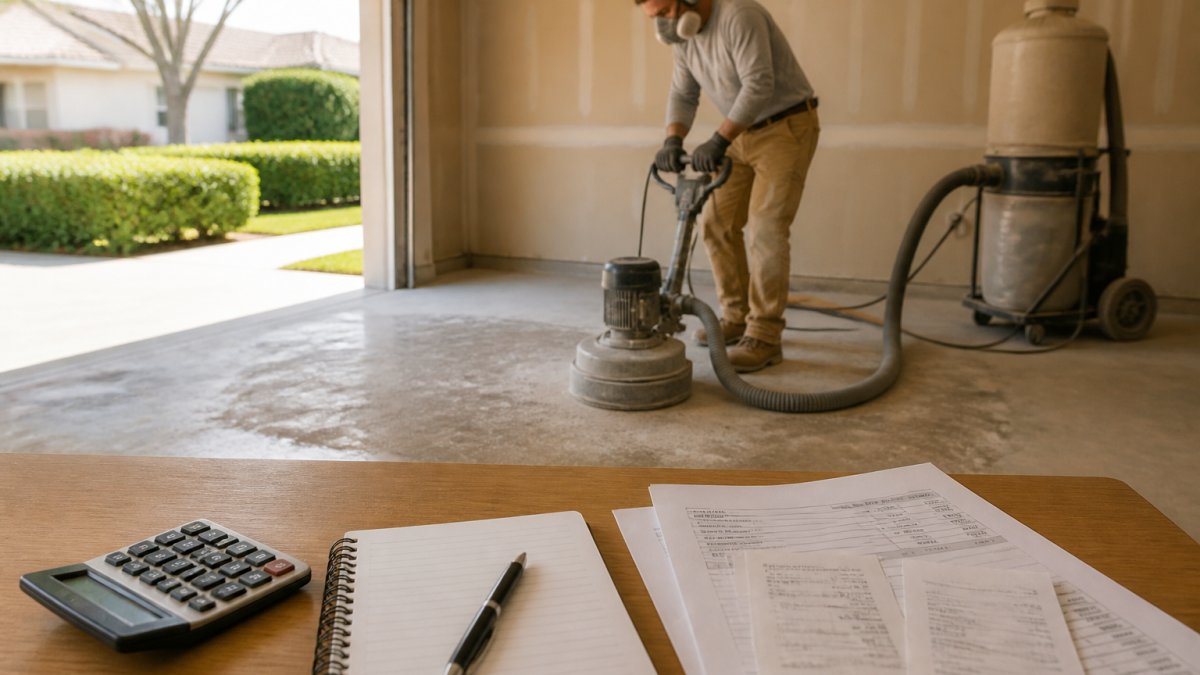
Here is what each prep step involves and roughly what it adds to a project. These are planning ranges for a typical residential slab, not quotes.
- Diamond grinding. This profiles the concrete so epoxy can mechanically bond. It is non-negotiable for a lasting floor. Expect roughly $1 to $2 per square foot, or a few hundred dollars on a two-car slab. A grinder rental alone runs around $100 to $200 per day, plus diamond tooling and dust control.
- Crack and spall repair. Hairline cracks are filled with a rigid or semi-rigid epoxy patch; larger ones may need routing before patching. Minor crack filling is often a few hundred dollars; extensive routing and patching can add $500 to $1,500 or more on a badly cracked slab.
- Oil and stain removal. Contaminated areas must be cleaned and abraded or the coating will not adhere. Spot treatment is inexpensive; widespread oil saturation may require grinding deeper or applying a primer, adding a few hundred dollars.
- Moisture testing and mitigation. A slab that wicks moisture will push a coating off from below. Testing is quick and low-cost, but if the slab fails, a moisture-mitigation primer or a vapor barrier system can add several hundred to over a thousand dollars.
- Spalling and delamination. Flaking, chipped concrete is a structural surface problem, not a stain. Repairing spalled areas with a patching compound and re-leveling can be one of the largest prep costs on an older floor.
How Concrete Condition Changes the Estimate
This is the part headline per-square-foot prices hide. A clean, sound slab might need only grinding and a light crack fill, while a slab with active moisture, deep cracks, and oil saturation can double the prep line item, often the largest single cost in the project.
Think of it this way: the coating is a fixed cost per square foot, but prep is a variable cost that depends entirely on what is under your feet. A quote that seems high may reflect an honest assessment of the concrete; a quote that seems low may be skipping steps you cannot see.
DIY Epoxy Kit vs Professional Installation: Real Cost Comparison
DIY epoxy kits look cheaper on the shelf, and sometimes they are. The catch is that the kit price excludes the equipment and labor that make a floor last, and the cost of failure.
A fair comparison weighs the full scope, not just the box:
| Factor | DIY Kit | Professional Installation |
|---|---|---|
| Surface prep | Hand tools, often acid etch only | Diamond grinding, full profiling |
| Crack repair | Limited, homeowner-supplied | Included in scope |
| Material quality | Varies, often thin | 100% solids, measured thickness |
| Equipment | Rented or purchased | Contractor-owned |
| Labor | Your weekends | Trained crew |
| Failure risk | High if prep is skipped | Low with proper prep |
| Warranty | None | Backed by the installer |
The real difference comes down to prep and material. A homeowner can absolutely coat a clean, sound slab with a quality kit and get a decent result.
Where DIY falls short is when the slab needs grinding and repair. Renting a grinder, managing dust, and patching cracks correctly is skilled work, expect the prep to be the hard part, not the coating.
Coating Systems Compared: Epoxy Paint, 100% Epoxy, and Flake Finishes
Not all epoxy is the same product, and the name on the can tells you less than the solids content does.
Epoxy paint is a single-part product, often water-based, that cures to a thin film.
100% solids epoxy is a two-part system that cures thick and hard. It resists hot-tire pickup, chemicals, and abrasion far better.
Decorative flake finishes broadcast vinyl flakes into the wet epoxy, then seal with a clear topcoat. The flakes hide minor flaws, add grip, and give a showroom look.
Epoxy Floor Curing Time and How It Affects Your Timeline
Curing time is the part of the schedule homeowners forget. Epoxy needs time to harden before it takes weight, and the clock starts after the final coat, not after the crew leaves.
Rough timeline for a typical project:
- Application day. Coats go down and the floor begins to set.
- Foot traffic. Usually allowed within a day, once the surface is firm.
- Vehicle traffic. Typically several days, depending on temperature and system thickness.
- Full cure. Can take up to a week or more before heavy use and hot tires.
Cooler temperatures and thicker systems extend every stage. Plan to keep the garage empty longer than you think, and clear it out before work begins. Rushing a cure is one of the fastest ways to ruin a fresh floor.
Long-Term Value: Lifespan, Maintenance, and Resale Impact
A properly installed epoxy floor is a long-term asset, not a cosmetic upgrade.
Maintenance is minimal: sweep regularly, mop with a mild cleaner, clean up spills before they set, and avoid harsh solvents that dull the topcoat.
For resale, a clean, coated garage reads as a finished, cared-for space.
A garage floor is one of the few home upgrades that pays you back in durability and resale appeal, but only when the prep and the coating are done right.
Frequently Asked Questions
How much does it cost to epoxy a 2-car garage?
A standard two-car garage runs about 400 to 500 square feet. Professional epoxy garage floor cost for that size typically falls in the mid-range of the market, with the final number driven by concrete condition, coating system chosen, and whether crack repair or grinding is needed. Get a written quote that itemizes prep, materials, labor, and number of coats so you can compare apples to apples.
How long will an epoxy garage floor last?
A properly installed epoxy floor can last 10 to 20 years or more, depending on coating thickness, surface preparation quality, and traffic. The biggest factor is adhesion, which comes down to concrete prep. Floors that peel early almost always skipped proper grinding or had moisture issues that were not addressed before coating. A clear topcoat adds scratch and UV resistance, extending lifespan further.
What is the downside of an epoxy garage floor?
Epoxy is slick when wet unless an anti-slip additive is used, and it can yellow under UV exposure if the topcoat is not UV-stable. Hot tires can cause tire marks on lower-quality coatings. It also requires careful surface preparation; a poorly prepped floor will peel. Curing time means you cannot park on it for several days after installation.
Does epoxy flooring increase home value?
A clean, well-installed epoxy floor improves curb appeal and perceived maintenance quality, which can help during showings. Real estate agents often note that a finished garage reads as a cared-for property. The return depends on your local market and buyer preferences, but the upgrade rarely hurts and often helps a home stand out against comparable listings with bare concrete.
What factors influence the total cost of professional epoxy installation?
The main cost drivers are garage square footage, concrete condition (cracks, spalling, moisture), the coating system selected (epoxy paint vs 100% solids vs flake system), number of coats, and whether a clear topcoat is included. Surface preparation like grinding and crack repair adds labor. Regional labor rates and project timing also shift the final quote.