 How-to
Why Salt Air Damages Stucco Homes: Causes & Fixes
Last Updated: October 23, 2026
Quick Summary
Salt air damage happens when wind-driven ocean spray deposits sodium chloride on porous stucco, where capillary action pulls dissolved salt into the pores. As the wall dries, salt crystals form inside the pore structure and exert pressure that cracks, spalls, and crumbles the stucco over repeated wet-dry cycles.
- Rinse exposed coastal walls with fresh water every 3-4 months to remove surface salt before it migrates inward.
- Inspect stucco at least twice a year and after any major storm, logging changes with photos.
- Seal only clean, dry, salt-free stucco, since sealing over salt traps crystals under the coating.
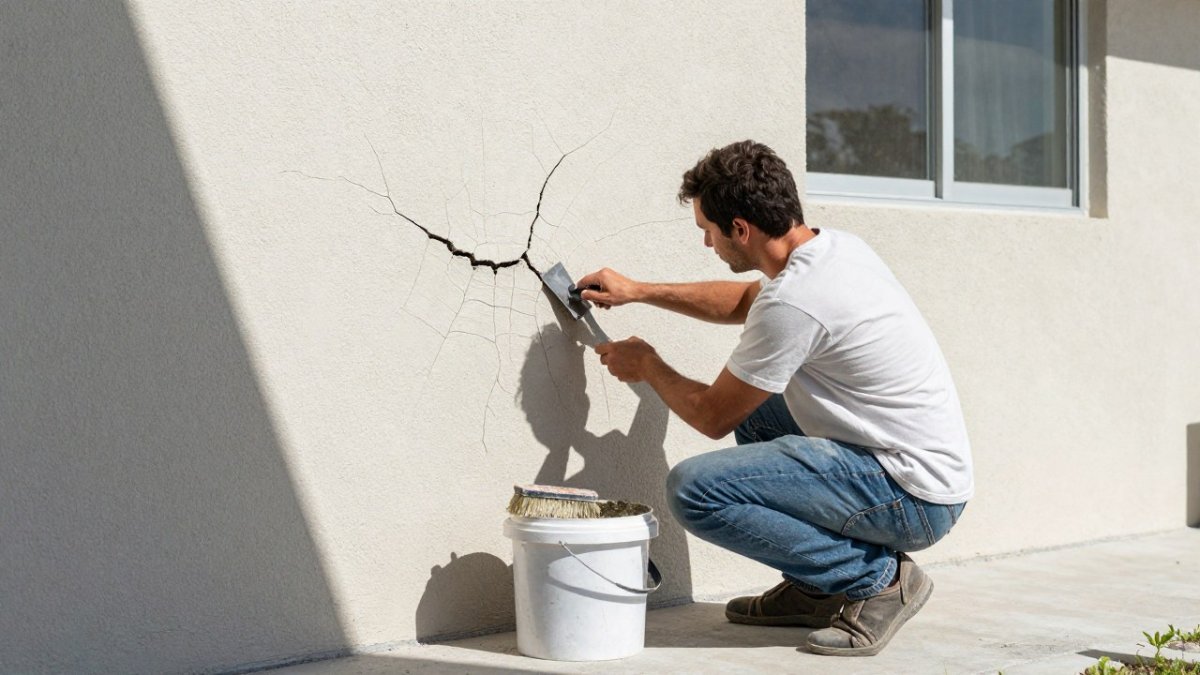
- Hairline cracks under 1/16 inch can be patched and repainted; recurring cracks in the same spot need pro inspection.
- Wet a white deposit with a spray bottle: efflorescence dissolves, mold and mildew do not.
Table of Contents
- How Salt Air Reaches and Settles on Stucco
- The Damage Mechanism: From Salt Crystal to Stucco Failure
- Signs of Stucco Water Damage You Should Never Ignore
- How to Tell Salt Damage From Other Stucco Problems
- How to Protect Stucco From Salt Air
- How Often to Inspect Stucco on a Coastal Home
- Stucco Repair Near the Coast: When to Patch and When to Call a Pro
- Conclusion
- Frequently Asked Questions
How Salt Air Reaches and Settles on Stucco
Salt air damage starts long before you see a single crack. Ocean spray lifts tiny droplets of seawater into the air, and wind carries them inland. Each droplet holds sodium chloride, the same salt on your dinner table. When that mist lands on a stucco wall, the water evaporates and leaves the salt behind.
Stucco is a porous surface. Look closely and you will see millions of tiny stucco pores, each one a perfect landing spot for salt particles. The wall soaks them up like a sponge.
Coastal exposure makes this a daily event, not a rare one. A marine layer that hangs over the neighborhood keeps walls damp for hours. Then the sun dries them. Then the cycle repeats.
That wet-dry cycle is the engine behind most coastal stucco problems. Chalky white film, dull paint, and hairline cracks that were not there last season are common results. The salt is not just sitting on the surface. It is working its way in.
The Damage Mechanism: From Salt Crystal to Stucco Failure
Most guides stop at "salt holds moisture and cracks stucco." The actual mechanism is a sequence of physical steps, and understanding each one tells you what to inspect and when to call a professional.
Step 1: Deposition. Wind-driven ocean spray carries sodium chloride droplets onto the wall.
Step 2: Absorption. Stucco is a porous cementitious material. Capillary action pulls dissolved salt into the pore structure.
Step 3: Crystallization. As the wall dries, water evaporates and salt concentration rises until crystals form. Crystal growth exerts pressure against pore walls (Multiscale simulation of salt crystallization-induced damage in porous materials).
Step 4: Wet-dry cycling. Each cycle dissolves salt, draws it deeper, and re-crystallizes it. This is why coastal homes deteriorate faster than inland homes exposed to the same rain.
Step 5: Surface failure. Once internal pressure exceeds the tensile strength of the stucco, you see hairline cracking, then spalling, then crumbling.
Measurable indicators to track. You do not need a laboratory to judge progression. Track these over time:
- Recurrence of white deposits after cleaning, a sign salt is still migrating from within.
- Crack width, hairline cracks under 1/16 inch are often early-stage; cracks that widen or return after patching suggest active moisture.
- Hollow or soft areas when tapped, a sign the stucco has detached from the substrate.
- Moisture readings, a pin-type moisture meter used by a stucco professional can confirm whether the wall is staying damp behind the finish.
- Paint adhesion, chalking and fading precede peeling; peeling means water is already under the coating.
How this differs from other stucco problems. Efflorescence is a surface deposit that dissolves when wet. Subflorescence damage does not dissolve; it leaves cracking and crumbling.
Signs of Stucco Water Damage You Should Never Ignore
Watch for these warning signs. Each one points to moisture intrusion behind or inside the stucco:
- White, powdery deposits on the surface, called efflorescence
- Paint fading, peeling, or bubbling away from the wall
- Hairline cracking that spreads or returns after patching
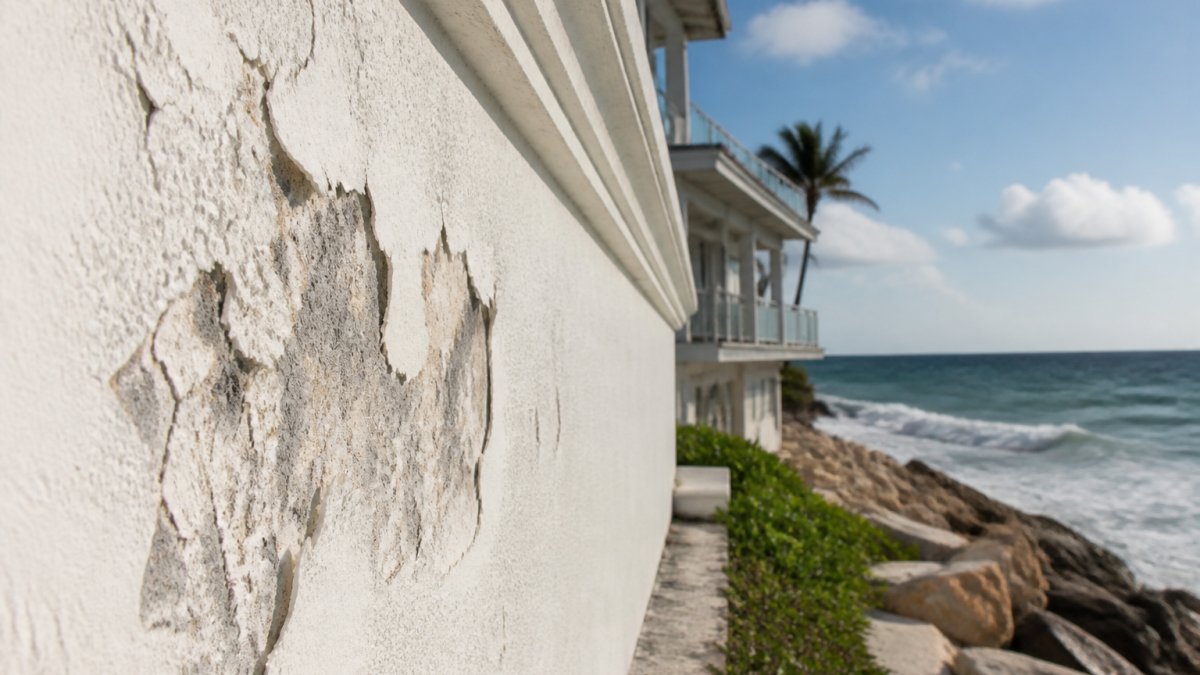
- Crumbling or flaking stucco, especially near the base
- Soft or hollow-sounding spots when you tap the wall
- Rust streaks from metal fasteners bleeding through
- Mold, mildew, or algae staining in shaded areas
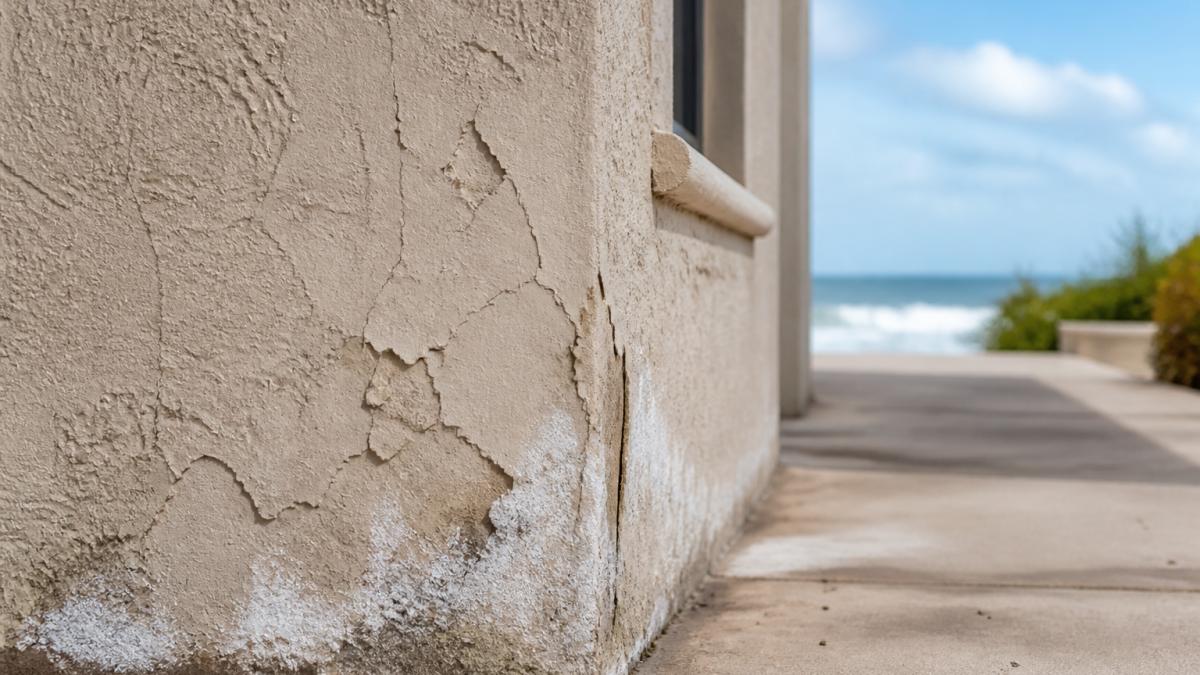
One sign alone is a warning. Two or more together usually mean active moisture intrusion. Do not wait for the wall to crumble before you act.
How to Tell Salt Damage From Other Stucco Problems
Salt damage has a signature. Learn it and you can avoid paying for the wrong repair.
Salt damage looks like this:
- White deposits that come back after cleaning
- Damage concentrated on windward walls and lower sections
- Cracking that returns in the same spots after patching
- Paint failure that starts as fading, then peeling
Other problems look different:
- Settlement cracks run in long, straight lines and do not come back after proper patching
- Poor original application shows up as uniform cracking across the whole wall, often soon after construction
- Roof or plumbing leaks cause damage in one localized area, usually near a penetration or under a window
The tell is recurrence. Salt damage keeps coming back because the salt is still in the wall. A crack that returns to the same spot after a good patch is a moisture problem, not a cosmetic one.
How to Protect Stucco From Salt Air
Protection is not one product or one habit. It is a maintenance routine matched to how much salt your wall actually receives.
Clean with fresh water, not force. Rinse walls with a garden hose and a soft brush every few months to remove surface salt before it migrates inward. Work from the top down so dirty water does not streak clean sections.
Do not use incompatible cleaners. Acid-based cleaners, harsh solvents, and bleach-heavy mixes can etch or discolor stucco and damage surrounding paint and metal. Check that any cleaner is labeled safe for cementitious stucco.
Seal only clean, dry, salt-free stucco. A breathable sealant or coating slows water penetration while letting trapped moisture escape. Apply it after cleaning and after the wall has dried. Sealing over salt traps the problem.
Fix water paths before you seal. Check gutters, downspouts, irrigation heads, and grading. Water pooling at the base of the wall is a common source of moisture intrusion near the coast.
Repaint on schedule, not after failure. Paint is the first line of defense. When it fades or chalks, the stucco is exposed. Repaint before peeling starts, and never paint over active salt deposits or damp stucco.
Tailor prevention to exposure and building details.
- Distance from the coast and prevailing wind, windward walls take more salt and need more frequent rinsing and inspection than leeward walls.
- Sheltered walls, walls under deep overhangs or blocked from rain by adjacent structures may accumulate salt without the rinsing benefit of rain; inspect them as often as exposed walls.
- Lower walls and splash zones, the base of the wall concentrates salt from splash-back and needs the most attention.
- Roof and window details, poorly detailed flashing and window trim let water behind the stucco, compounding salt damage.
- Drainage, keep the base of the wall dry; standing water accelerates every mechanism described above.
A practical maintenance cadence.
- Rinse walls every 3-4 months on exposed coastal homes; less often on sheltered inland walls.
- Inspect twice a year and after major storms.
- Reapply sealant per the manufacturer's schedule.
- Repaint before paint failure starts, not after.
- Keep sprinklers off the walls.
How Often to Inspect Stucco on a Coastal Home
Inspect stucco at least twice a year, and after any major storm. Coastal homes face constant salt exposure, so twice-yearly checks catch small problems before they become repairs.
Walk the exterior and check these spots:
- Lower walls and the base, where splash-back concentrates salt
- Windward-facing walls that take the most ocean spray
- Around windows, doors, and hose bibs
- Under roof overhangs and gutters
- Any spot where paint looks dull or chalky
Note anything new each time. A photo log makes changes easy to spot. If you see recurring efflorescence, fresh cracking, or soft spots, get a professional opinion before the next rainy season.
Stucco Repair Near the Coast: When to Patch and When to Call a Pro
Small problems you can patch. Big ones need a pro. Use this guide to decide.
| What You See | Likely Cause | Action | Urgency |
|---|---|---|---|
| Light efflorescence, no cracks | Surface salt deposits | Wash and monitor | Low |
| Hairline cracks under 1/16 inch | Minor shrinkage or early salt damage | Patch and repaint | Medium |
| Recurring cracks in the same spot | Moisture intrusion | Pro inspection | High |
| Crumbling, soft, or hollow stucco | Salt crystallization damage | Pro repair, likely cut-out | High |
| Rust streaks from fasteners | Corrosion of metal components | Pro repair and re-flash | High |
| Widespread peeling paint | Paint adhesion failure | Prep, patch, and repaint | Medium |
Patching works when the cause is cosmetic. It fails when salt or water is still active behind the surface. That is why we start every coastal repair by finding the moisture source, not by grabbing a bucket of patch.
Our stucco patch, match, and paint service handles the full job.
On a coastal home, a repair that ignores the salt and moisture source will fail. Fix the cause first, then patch, then protect.
Conclusion
Salt air damage is relentless on coastal homes, and it will not stop on its own. The good news is that most of it is preventable with regular cleaning, timely sealing, and repairs that address the cause instead of the symptom.
If your stucco is showing cracks, chalky deposits, or peeling paint, do not paint over it and hope. Florence Painting Aloha offers thorough power washing and surface prep, stucco patch, match, and paint service, and a satisfaction guarantee: if you are not completely satisfied, we will fix it. Our transparent process takes you from consultation to delivery with no surprises.
Schedule a bid with Florence Painting Aloha and protect your stucco before the next season of salt air takes its toll.
Frequently Asked Questions
What are the first signs of salt air damage on stucco?
Watch for a chalky white film, called efflorescence, along with paint that fades or peels in sheets. Hairline cracking, flaking stucco near the base of the wall, and rust streaks around fasteners usually follow. Because salt crystals pull moisture into the stucco pores, these signs often appear first on walls facing the ocean and on surfaces that stay shaded most of the day. Catching them early keeps small surface issues from turning into moisture intrusion behind the stucco.
How often should coastal stucco be inspected and cleaned?
Plan on a visual check twice a year and a full professional inspection every 12 to 24 months. Homes within a few blocks of the water, or with walls that never dry out, need the shorter end of that range. Rinse salt residue off with fresh water every few months, and schedule a deeper cleaning before repainting. After any major storm, walk the exterior and look for new cracks, blisters, or paint lifting away from the wall.
Can salt-damaged stucco be repaired, or does it need replacing?
Most salt damage is repairable when it is caught before the stucco crumbles. Surface deposits, peeling paint, and hairline cracks respond well to cleaning, patching, and a fresh coating system. Once stucco is soft, hollow-sounding, or separating from the wall, that section needs to be cut out and rebuilt. Stucco repair near the coast should always include fixing the water source, not just covering the crack, or the damage returns within a season.
Does paint protect stucco from salt air?
Paint helps, but only when the wall is prepped and the coating is designed for coastal exposure. Paint adhesion fails fast on a dirty or damp surface, so power washing and full dry time come first. Elastomeric or masonry coatings bridge small cracks and slow water penetration better than standard exterior paint. No coating seals stucco permanently, though, so plan on repainting every five to seven years in a salt-heavy environment.