 How-to
Why Do Stucco Cracks Keep Coming Back After Repair?
Quick Summary
Stucco cracks often return after a patch because the repair treats the symptom instead of the cause. Movement in the wall or water getting behind the stucco keeps stressing the fix, so the crack reopens. Finding and correcting the cause before patching is what keeps a repair closed.
- Diagnose the cause first, since patching without finding it lets movement or water keep working.
- Cracks wider than 1/8 inch, growing cracks, or cracks with water staining need professional inspection.
- Mark both crack ends with a dated pencil line and re-measure over two to four weeks to check movement.
- Use a flexible material for moving cracks, because rigid filler cracks again along the same line.
- Allow proper curing and avoid painting too soon, since trapped moisture weakens the repair.
Table of Contents
- Why Stucco Cracks Keep Returning After a Patch
- Stucco Cracks: When to Worry About Cosmetic vs. Structural Damage
- Common Causes of Recurring Stucco Cracks in Jupiter's Coastal Climate
- A Diagnostic Sequence to Find the Underlying Cause
- Do Hairline Cracks in Stucco Need to Be Repaired?
- How to Repair Large Stucco Cracks So They Stay Closed
- Common Stucco Repair Mistakes That Bring Cracks Back
- Booking a Stucco Crack Inspection and Repair With Florence Painting Aloha
- Frequently Asked Questions
Why Stucco Cracks Keep Returning After a Patch
Stucco cracks often come back after a patch because the patch treats the symptom, not the cause. In coastal Jupiter, salt air, humidity, and daily temperature swings keep stucco moving, so a fresh filler can crack again within a season or two. ASTM C926 standard for portland cement plaster application
Most homeowners see a crack, fill it, paint over it, and move on. That works for a hairline crack caused by age. It does not work when the wall is still shifting or water is still getting in behind the surface.
A sound repair starts with finding out why the crack formed before you touch it. Repairs that skip this step tend to fail.
Stucco Cracks: When to Worry About Cosmetic vs. Structural Damage
A stucco crack is cosmetic when it is fine, shallow, and stable. It is structural when it is wide, growing, or paired with other signs of wall or foundation movement.
Watch for these warning signs:
- Cracks wider than 1/8 inch
- Diagonal cracks that start at window or door corners
- Cracks that grow after a patch
- Bulging, soft, or hollow-sounding stucco
- Water stains or peeling paint near the crack
Hairline cracks alone rarely signal a serious problem. A crack that keeps widening or shows water staining should be checked by a professional before you patch it.
Common Causes of Recurring Stucco Cracks in Jupiter's Coastal Climate
Jupiter's climate puts extra stress on exterior walls. Heat, humidity, salt air, and summer storms all push stucco to expand, contract, and absorb moisture. Local homes also sit on sandy soil that can settle over time.
Building Movement, Settlement, and Temperature Swings
Stucco is a rigid cement-based material. It has little give. When the framing under it moves, or when the wall heats up in the afternoon and cools at night, the stucco is pulled in different directions.
Patching these cracks without addressing the movement means the same stress will open the repair again. Compare the options in repair versus replacement for coastal stucco homes.
Moisture Intrusion, Flashing, and Drainage Failures
Water is the most common reason a repaired crack fails. Learn how to remove salt buildup from exterior walls that can add to this damage. Stucco is not fully waterproof. Water that gets behind it through a cracked wall, failed flashing, clogged gutters, or poor drainage can freeze, expand, and break the bond again.
Check these areas before you repair:
- Window and door flashing
- Gutters and downspouts that dump water against the wall
- Grade, meaning soil that slopes toward the house
- Plumbing or irrigation lines near the wall
- Rooflines that drip onto stucco
Fixing the water source is often the only way to keep a crack closed.
A Diagnostic Sequence to Find the Underlying Cause
Most repeat failures happen because the repair was chosen before the cause was identified. A short, disciplined diagnostic sequence prevents that. Work through these steps in order, and do not patch until you can explain why the crack formed.
- Document the crack before you touch it. Photograph the full wall and a close-up with a tape measure or coin for scale. Record the date, the compass orientation of the wall, and whether the crack is on a sun-exposed or shaded elevation. In Jupiter, south- and west-facing walls take the most afternoon heat and thermal movement, so orientation matters when you compare cracks over time.
- Measure width and classify it. Use a crack gauge or a feeler gauge. Hairline is generally under 1/16 inch; cracks between 1/16 and 1/8 inch deserve monitoring; anything at or above 1/8 inch, or any crack that is wider at one end, warrants a professional look. Note whether the edges are sharp (fresh movement) or rounded and dirty (older, stable crack).
- Map direction and pattern. Vertical cracks often follow control joints or framing seams. Diagonal cracks that radiate from window and door corners usually point to movement or settlement. Map-cracking (a random, interconnected pattern) often points to shrinkage or a weak base coat. Cracks that step along a mortar joint or block course can indicate differential movement.
- Check for moisture evidence. Look for efflorescence (white powder), dark staining, soft or hollow-sounding stucco when tapped, bubbling paint, or mold at the interior drywall. Probe gently with a moisture meter if you have one. Water behind stucco is the most common reason a patch fails, and in South Florida's humid climate trapped moisture does not dry quickly.
- Inspect the water-management details. Confirm that flashing at windows, doors, and rooflines directs water out and down. Check that weep screeds at the base of the wall are open, not buried in soil or caulk. Verify that gutters and downspouts discharge away from the wall and that the grade slopes away from the foundation. A crack that returns near a downspout or below a window is often a drainage problem, not a stucco problem.
- Monitor before you commit. Mark both ends of the crack with a pencil line and the date. Re-measure in two to four weeks, and again after a heavy rain or a cold front. A crack that has not moved and shows no moisture is a candidate for a cosmetic repair. A crack that has lengthened, widened, or reappeared in the same line is telling you the cause is still active.
- Decide with the evidence in hand. Match the repair to the cause: flexible sealant or elastomeric coating for stable hairline cracks, mesh-reinforced cement patch for stable larger cracks, and investigation of framing, drainage, or foundation before any patch when movement or moisture is present.
Watch out: marking a crack and then painting over the marks before the monitoring period ends destroys the only record you have of whether it is moving.
ASTM C926 standard for portland cement plaster application
Do Hairline Cracks in Stucco Need to Be Repaired?
Many hairline cracks do not need major repair. A crack thinner than about 1/16 inch that is not growing and shows no water damage is often cosmetic. Sealing it with a flexible elastomeric coating can keep water out without a full patch.
Still, a hairline crack is worth sealing. It is much cheaper to seal early than to rebuild a wall after water gets inside.
How to Repair Large Stucco Cracks So They Stay Closed
A large crack needs a repair that can accommodate some movement and bond to sound material. The steps below reflect common practice among experienced plasterers and stucco contractors.
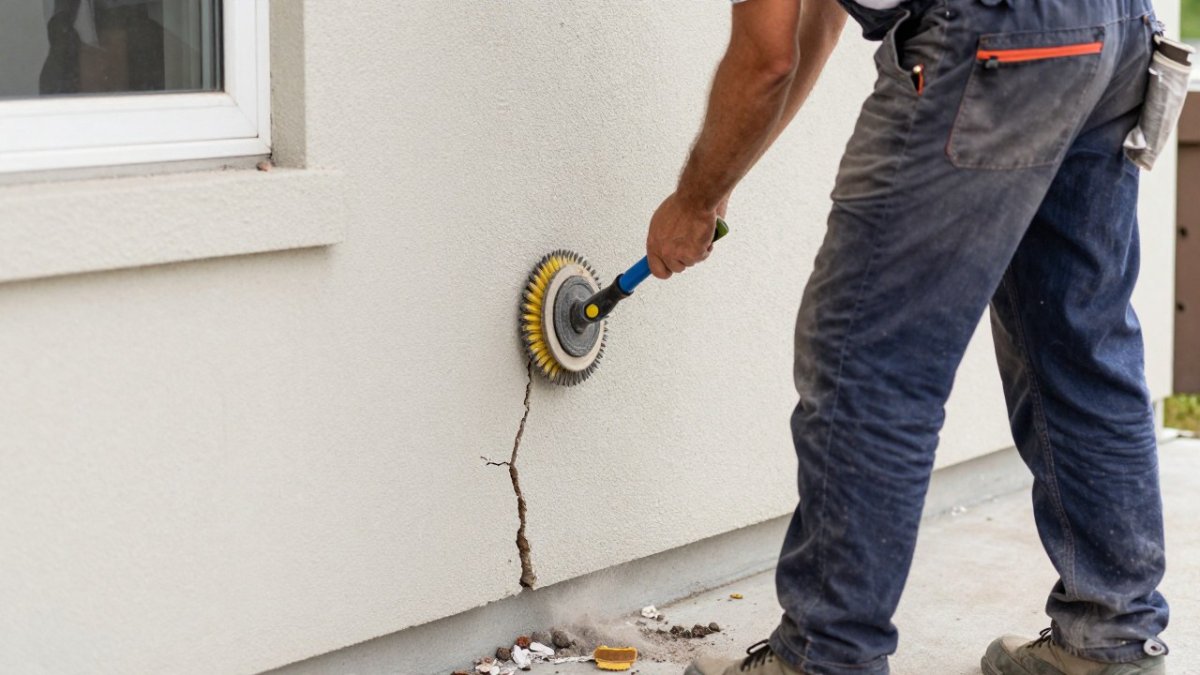
- Clean and open the crack. Remove loose stucco, dirt, chalky residue, and old paint with a wire brush or a grinder. Undercut the edges slightly so the patch keys into the wall rather than sitting on top of it. A patch that only bridges the surface has nothing to hold onto.
- Dampen, do not soak. Lightly mist the prepared area so the existing stucco does not pull water out of the patch too quickly. On a hot Jupiter afternoon, a dry substrate can flash-dry a cement patch and cause shrinkage cracking before it cures.
- Choose a compatible material. Cement-based patching compounds bond well to portland cement stucco and are the usual choice for structural fills. Acrylic or elastomeric patching compounds flex more and suit cracks that may still move slightly, but they can be too soft for deep fills. Sealants alone are for joints and hairline cracks, not for wide, deep cracks that need structural fill. Mix only what you can place within the product's working time.
- Reinforce wide cracks. For cracks wider than about 1/8 inch, embed fiberglass mesh or a suitable reinforcing tape across the crack before the patch sets. The mesh spreads movement across a wider area instead of concentrating it at one line.
- Fill in layers. Build the patch in lifts rather than one thick application. Overfilling a deep crack in one pass traps air and water and increases shrinkage. Follow the manufacturer's recoat window; most cement-based patches want a damp-cured surface between lifts.
- Cure properly. Cement-based patches need moisture to cure, not to dry. Keep the patch damp per the product instructions, and protect it from direct sun and wind for the first day. Many products require several days before painting. Painting too early traps moisture and is a common cause of a repair failing within a season.
Watch out: using a rigid, fast-setting filler on a crack that is still moving will produce a new crack along the same line, often within one weather cycle.
A contractor cleaning out a crack with a wire brush before patching is shown below.
Common Stucco Repair Mistakes That Bring Cracks Back
These mistakes cause most repeat failures:
- Patching without finding the cause. The movement or water keeps working.
- Skipping surface prep. Loose debris and dust stop the patch from bonding.
- Using a rigid filler on a moving crack. It cracks again when the wall shifts.
- Painting too soon. Trapped moisture weakens the repair.
- Ignoring drainage. Water that runs against the wall undoes the fix.
- Using a mismatched material. Some patches do not bond well to older stucco.
Avoid these and your repair has a much better chance of holding.
The article lists the mistakes that most often cause repeat failures, summarised below.
| Mistake | Why it fails | Better approach |
|---|---|---|
| Patching without finding the cause | Movement or water keeps working | Diagnose the cause first |
| Skipping surface prep | Debris stops the patch bonding | Clean and open the crack |
| Rigid filler on a moving crack | Cracks again as the wall shifts | Use a flexible material |
| Painting too soon | Trapped moisture weakens the repair | Allow proper curing |
| Ignoring drainage | Water running down the wall undoes the fix | Correct gutters and grade |
| Mismatched material | Some patches bond poorly to older stucco | Choose a compatible material |
Booking a Stucco Crack Inspection and Repair With Florence Painting Aloha
If your stucco cracks keep coming back, the cause probably needs a professional look. Florence Painting Aloha provides thorough power washing and surface preparation, and stucco patch, match, and paint services. The company stands behind its work with a satisfaction guarantee.
For a free estimate, contact Painting Services in Jupiter, FL or request a free estimate by calling or texting (561) 323-8766.
Frequently Asked Questions
Is it normal for stucco to crack after install?
Some hairline cracking is common in new stucco as the material cures and the building settles. Cracks that are wider than a hairline, that grow over time, or that appear around window and door openings deserve attention. Those patterns usually point to movement, moisture or a poor bond rather than normal curing, so have the cause checked before you patch.
When should you worry about stucco cracks?
Worry when a crack is wider than about 1/8 inch, keeps lengthening, runs diagonally from a window or door corner, or comes with bulging, soft spots, staining or peeling paint. Those signs can mean foundation movement or water getting behind the stucco, which a cosmetic patch will not fix. A professional inspection can tell you whether the crack is structural or moisture-related.
What causes stucco cracks to return after repair?
Most recurring cracks come back because the original cause was never addressed. Building movement, temperature-driven expansion and contraction, and water entering through failed flashing or poor drainage will keep stressing the same spot. Patches also fail when the surface was not cleaned, the old cracked material was not properly bonded, or the repair material does not match the existing stucco.
What are the common mistakes to avoid when repairing stucco?
The most common mistakes are filling a crack without finding out why it formed, skipping removal of loose debris and chalky residue, using a patch material that is too rigid or incompatible with the existing stucco, and painting over a repair before it has cured. Repairs also fail when the crack is not widened and cleaned first, because the new material bonds to the surface rather than the crack's edges.