 Comparison
Are Epoxy Garage Floors Worth It in Florida? 7 Facts
Last Updated: November 5, 2026
Quick Summary
Epoxy garage floors are worth it in Florida for most homeowners who park vehicles inside and want a surface that resists oil, moisture and wear. The value depends heavily on slab preparation, moisture testing and a UV-stable topcoat, since Florida humidity and sun can cause early failure.
- Epoxy is usually worth the cost for daily-use garages, less so for rarely used storage rooms with sound, sealed slabs.
- Moisture vapor transmission is a common cause of epoxy failure in humid climates and should be tested before installation.
- Surface preparation often costs more than the coating itself, so a cheap quote that skips prep is usually a false economy.
- Standard epoxy can yellow near sunlit doors unless a UV-stable topcoat such as polyaspartic or polyurethane is used.
- Ask whether the warranty excludes hot-tire pickup, moisture and UV yellowing, since those are the most common Florida failure modes.
Table of Contents
- Are Epoxy Garage Floors Worth It in Florida's Climate?
- Benefits of Epoxy Coatings Compared With Bare Concrete
- How Florida Humidity, Heat and UV Affect Epoxy Garage Floors
- Epoxy Garage Floor Cost and Lifecycle Value
- Epoxy Garage Floor Pros and Cons for Jupiter Homeowners
- Polyaspartic Garage Floor Versus Epoxy: Which Holds Up Better?
- Booking Your Garage Floor Assessment With Florence Painting Aloha
- Frequently Asked Questions
Are Epoxy Garage Floors Worth It in Florida's Climate?
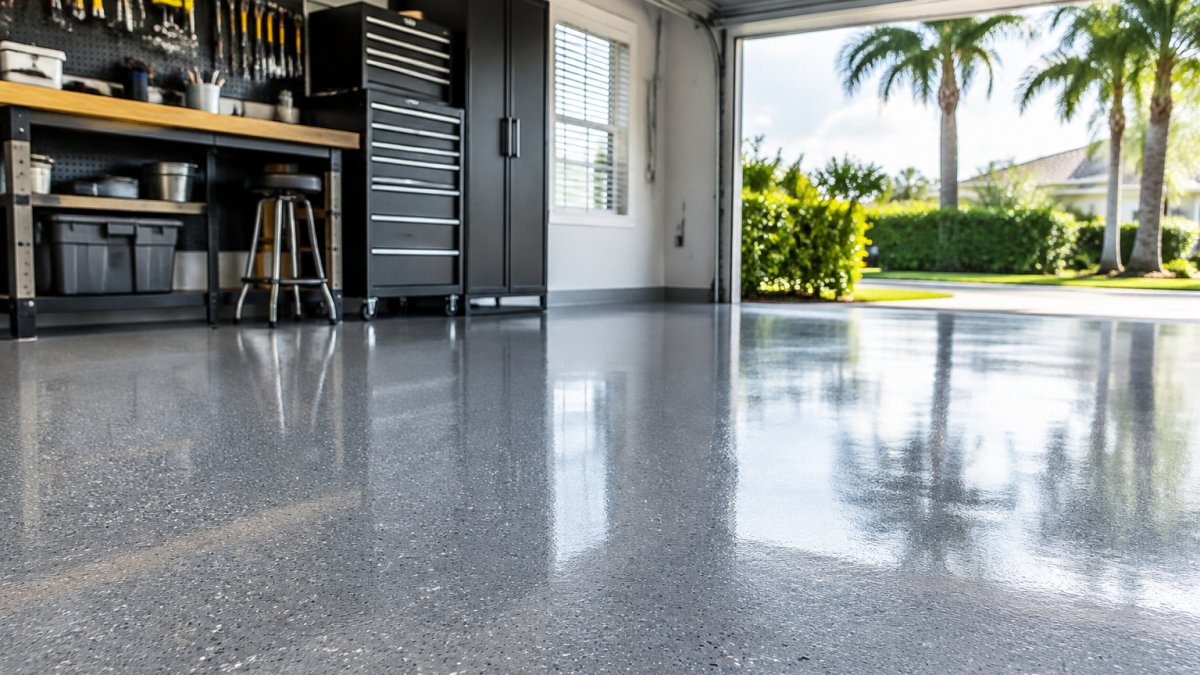
Epoxy garage floors are worth it in Florida for most homeowners who want a durable, easy-to-clean surface that resists moisture and vehicle wear. The case for epoxy is strongest when the garage takes daily abuse from cars, humidity and salt air.
Bare concrete in a Florida garage absorbs oil, traps moisture and shows every stain. An epoxy system seals the slab, which makes the floor easier to clean and less likely to dust or pit over time. Whether that matters to you depends on how you use the space.
Here is the short version. Epoxy is usually worth the money when the garage is a working space, when you park a vehicle inside daily, or when you plan to stay in the home long enough to recoup the cost. It is less compelling for a rarely used storage room with a slab that is already sound and sealed.
Florida adds specific pressures that shape the decision. Humidity, heat and sunlight all affect how a coating performs, so the surface preparation and the coating system you choose matter as much as the product itself.
Benefits of Epoxy Coatings Compared With Bare Concrete
Bare concrete is porous. Oil, tire rubber and cleaning chemicals soak in, which makes stains hard to remove. An epoxy coating creates a continuous, sealed surface that wipes clean with a damp mop and mild cleaner.
The practical benefits break down into a few areas:
- Stain resistance: Sealed surfaces resist oil, grease and many household chemicals better than raw concrete.
- Dust control: Coatings stop the fine concrete dust that bare slabs shed, which keeps shelves, tools and vehicles cleaner.
- Appearance: Flake, metallic and solid-color finishes can hide minor slab imperfections and give the garage a finished look.
- Easier maintenance: Routine cleaning takes less time and fewer products.
Epoxy does not make concrete immune to damage. A coating can still peel or chip if the surface was not prepared properly, and it can yellow or dull if it lacks a UV-stable topcoat. These limits are why installation quality matters more than the brand of coating.
How Florida Humidity, Heat and UV Affect Epoxy Garage Floors
Florida's climate tests every coating, and conditions can differ from one part of the state to another. Coastal air, afternoon thunderstorms and garage orientation all shape how a floor performs, so the same system may not suit every Florida garage.
Moisture vapor is the first risk. Concrete is porous, and in a humid climate the slab can pull moisture up from the soil below. If that vapor reaches the coating before it fully cures, or if it keeps pushing up afterward, the bond weakens and the floor bubbles or peels. Moisture vapor transmission is a common cause of epoxy failure in humid climates. A responsible installer tests for it before quoting. Common methods include taping a plastic sheet to the slab for 24 hours to see whether condensation forms, and a calcium chloride test that measures the rate of vapor movement. Some contractors also use a moisture meter. If the reading is high, the fix is a moisture-mitigation primer or a different coating system, not a thicker coat of epoxy.
Heat and hot-tire pickup come next. A car parked on a summer afternoon can leave tires hot enough to soften a lower-quality coating, and the tire can lift a patch of floor when the car pulls away. This is called hot-tire pickup, and it is most likely in the first days after installation and on systems without a heat-resistant topcoat. Curing temperature matters too: a garage that stays above roughly 60°F during application cures more predictably than one that swings cold at night. A contractor still needs to control the application window.
Sunlight and UV exposure are the third factor. Standard epoxy can yellow when UV light hits it, and the areas nearest a garage door that opens to the outdoors take the most sun. A UV-stable topcoat, often a polyaspartic or polyurethane clear, preserves color and gloss in those zones. Homeowners with a west- or south-facing door should ask specifically which topcoat is specified and whether it is warranted against yellowing.
Salt air adds a coastal wrinkle. Jupiter's proximity to the ocean means salt-laden air reaches the garage, especially near the door. Salt accelerates wear on metal, and on the floor it can leave a film that holds moisture against the coating. For more on protecting surfaces from corrosive coastal conditions, see this step by step guide to preventing salt corrosion on siding. A sealed, properly cured surface wipes clean more easily than bare concrete, but the homeowner should plan to rinse or damp-mop the apron and the first few feet inside the door more often than an inland garage would require.
Garage orientation and use change the answer. A garage that faces east gets morning sun and stays cooler in the afternoon; one that faces west bakes in the late-day heat. A garage used for daily parking, a workshop, or storage each puts different stress on the floor. The practical takeaway is that the same epoxy product can perform well in one garage and fail in another, so the assessment should start with the slab, the door orientation, and how the space is used.
Epoxy Garage Floor Cost and Lifecycle Value
Pricing depends on several factors, and the right way to judge value is to look beyond the upfront number. Here is a practical framework for thinking about cost, with the caveat that every figure should be confirmed in a written quote.
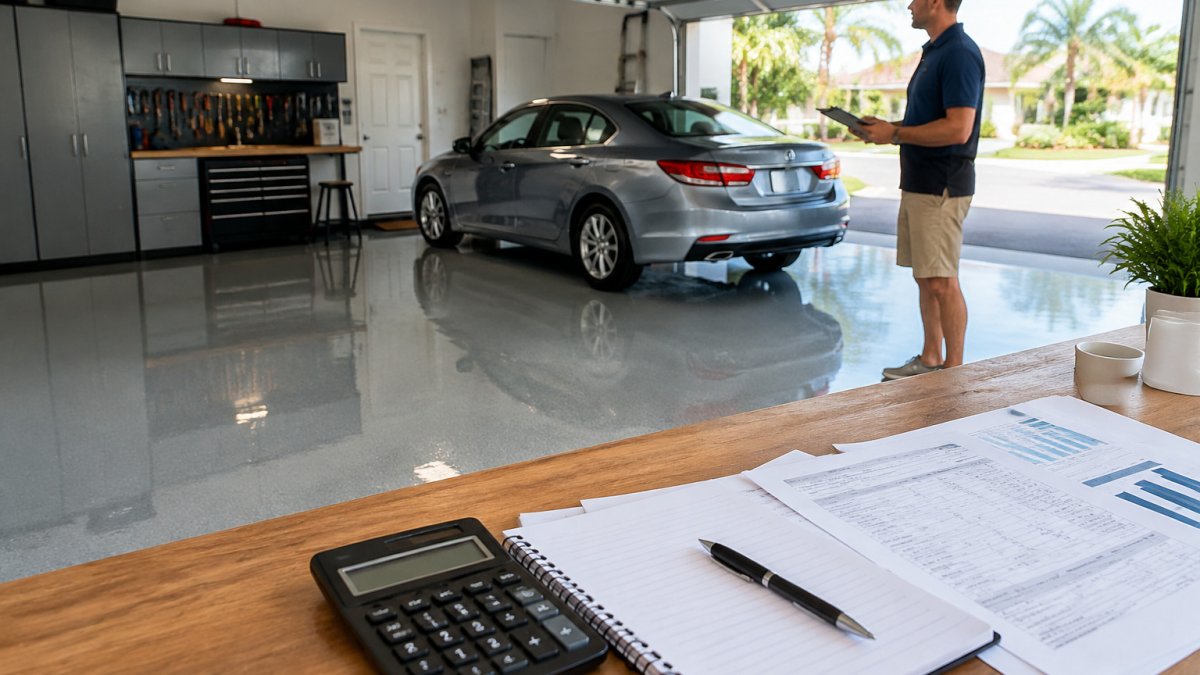
What drives the price. Four factors move the total more than the coating brand: square footage, the condition of the slab, the amount of surface preparation, and the coating system selected. A sound, clean slab in a two-car garage needs less work than a cracked, oil-stained slab that has never been coated. Preparation, including grinding, crack repair, and moisture testing, often costs more than the coating itself, which is why a cheap quote that skips prep is usually a false economy.
Realistic Jupiter-area ranges. Pricing depends on square footage, slab condition, surface preparation and the coating system selected. A bare, uncoated concrete slab costs nothing upfront but carries ongoing cleaning, staining, and dust costs that are easy to underestimate. Ask for a written quote that itemizes preparation and coating separately so you can compare bids fairly.
Lifespan and warranty. Service life depends on the system, the preparation and the conditions the floor faces. Product claims on the box often assume ideal preparation and no hot-tire or moisture stress, so real-world service life can be shorter. Warranty terms matter as much as the number: ask whether the warranty covers peeling and delamination, whether it excludes hot-tire pickup, moisture vapor transmission, UV yellowing, or improper substrate preparation, and whether it is prorated. A warranty that excludes the most common Florida failure modes is not much protection.
Lifecycle comparison. The right way to compare is cost per year of service. Comparing cost per year of service is more useful than comparing upfront prices alone, since a lower-cost floor that fails early can cost more over time. Bare concrete avoids the upfront cost but tends to need cleaning, patching, and eventually a coating anyway.
What to ask every contractor. Request a written quote that separates surface preparation, crack and spall repair, moisture testing, primer, base coat, and topcoat. Ask for the expected service life in a Florida garage, not a laboratory, and ask which failure modes the warranty excludes. A quote that is transparent on those points is easier to compare than one that quotes a single lump sum.
You can review service options and typical project scope on the epoxy garage floor cost guide page.
The article breaks down what drives epoxy garage floor pricing and how to judge value over time.
| Factor | What it affects | Why it matters |
|---|---|---|
| Square footage | Total price | Larger garages cost more to coat |
| Slab condition | Preparation work | Cracked or oil-stained slabs need more prep |
| Surface preparation | Share of total cost | Often costs more than the coating itself |
| Coating system | Price and performance | Selected system drives both cost and durability |
| Warranty terms | Real protection | Check whether it excludes hot-tire pickup and moisture |
Epoxy Garage Floor Pros and Cons for Jupiter Homeowners
Epoxy has clear advantages for Jupiter homes, but it is not right for every garage.
Pros:
- Seals the slab against oil, moisture and chemical stains
- Reduces dust and simplifies cleaning
- Available in many finishes, including decorative flake systems
- Can improve how the garage looks when it is shown to buyers
Cons:
- Poor preparation leads to peeling and early failure
- Standard epoxy can yellow near sunlit doors without a UV-stable topcoat
- Hot tires can cause pickup on some systems
- Quality installation costs more than a do-it-yourself kit
A DIY kit applied over an unprepared, moisture-prone slab can lead to premature failure and repeat costs.
Polyaspartic Garage Floor Versus Epoxy: Which Holds Up Better?
Polyaspartic coatings are a common alternative to epoxy. They generally cure faster and resist UV exposure well, which can matter for a garage with a sunny door. Epoxy often costs less and has a long track record. Both need proper preparation to perform well.
The right choice depends on your priorities. If you want a faster return to use and better UV color stability, polyaspartic is worth comparing. If budget and a proven system matter most, epoxy with a quality topcoat is often enough. Ask your installer which option suits your slab and how each is warranted.
Booking Your Garage Floor Assessment With Florence Painting Aloha
An on-site assessment is a good way to learn whether epoxy fits your garage. Reviewing the slab condition, moisture, and how the space is used helps explain the preparation and coating options. Our process is transparent from consultation to delivery, and we include thorough power washing and surface preparation in our work.
We also stand behind our work. If you are not completely satisfied, we will fix it. To discuss your garage, request a free estimate or contact us directly at (561) 323-8766. You can also see the full range of services we offer, including painting services in Jupiter, FL.
Frequently Asked Questions
How long does an epoxy garage floor last in Florida?
With proper surface preparation and a professionally applied system, an epoxy garage floor in Florida commonly lasts many years, though heat, humidity and UV exposure shorten its life when the topcoat is not UV-stable. Lifespan depends on the coating system, how well the concrete was prepared, how much vehicle traffic the floor sees and how consistently it is cleaned and resealed. Ask any installer for their warranty terms in writing so you know what is covered and for how long.
What is the average cost to epoxy a two-car garage floor?
Pricing depends on the square footage, the concrete condition, the number of coats, the type of system and the amount of surface preparation needed, so no single figure applies to every garage. Repairing cracks, grinding high spots or treating moisture problems adds to the total. Request a written quote that itemizes preparation, materials and labor in US dollars so you can compare the lifecycle value rather than only the upfront number.
Can you install an epoxy garage floor yourself?
A DIY kit can work on a small, dry, well-prepared slab, but adhesion depends heavily on surface preparation, moisture levels and mixing ratios. Florida humidity and slab moisture can cause bubbling or peeling when prep is skipped. Professional installation typically includes thorough degreasing, grinding and moisture assessment, which is the part most likely to determine whether the coating lasts.
Florence Painting Aloha helps Jupiter homeowners protect their garage floors with a sealed, durable epoxy system matched to Florida conditions. Schedule a bid today and get a clear plan for the surface your garage needs.