 Comparison
Marine Grade Paint vs Standard Exterior Paint: Which Wins?
Table of Contents
- Marine Grade Paint vs Standard Exterior Paint: What Actually Differs
- The Short Answer: When the Extra Cost Pays Off
- Marine Paint vs Regular Paint: Side-by-Side Comparison
- Best Paint for Salt Air Exposure: What Holds Up and What Fails
- Marine Paint for Wood: Planks, Trim, and Docks
- Marine Paint for Metal: Aluminum, Steel, and Corrosion Control
- Exterior Paint Durability Near the Ocean: What the Exposure Demands
- When Standard Exterior Paint Is the Right Choice
- Cost, Lifecycle Value, and a Quick Decision Framework
- Frequently Asked Questions
Last Updated: October 17, 2026
Marine Grade Paint vs Standard Exterior Paint: What Actually Differs
The difference between marine grade paint and standard exterior paint comes down to one thing: what the coating has to survive. Standard exterior paint is built for sun and rain on a house, not for a dock piling sitting in salt air year-round.
We work on coastal homes where salt air and humidity attack exterior surfaces every single day. That experience shapes how we think about this comparison.
Here's the part most guides get wrong: marine grade paint is not automatically "better" paint. It's a different tool. Put it on the wrong surface and you waste money. Use standard exterior paint on the wrong surface and you repaint in two years.
The Short Answer: When the Extra Cost Pays Off
Marine grade paint pays off when the surface faces direct salt spray, standing water, or constant humidity.
For a house wall set back from the water, standard exterior paint handles the job. Modern acrylic latex exterior paints resist moisture and UV well.
Marine coatings are often recommended for three situations: anything below the waterline, anything splashed by salt water regularly, and bare metal exposed to salt air.
Marine Paint vs Regular Paint: Side-by-Side Comparison
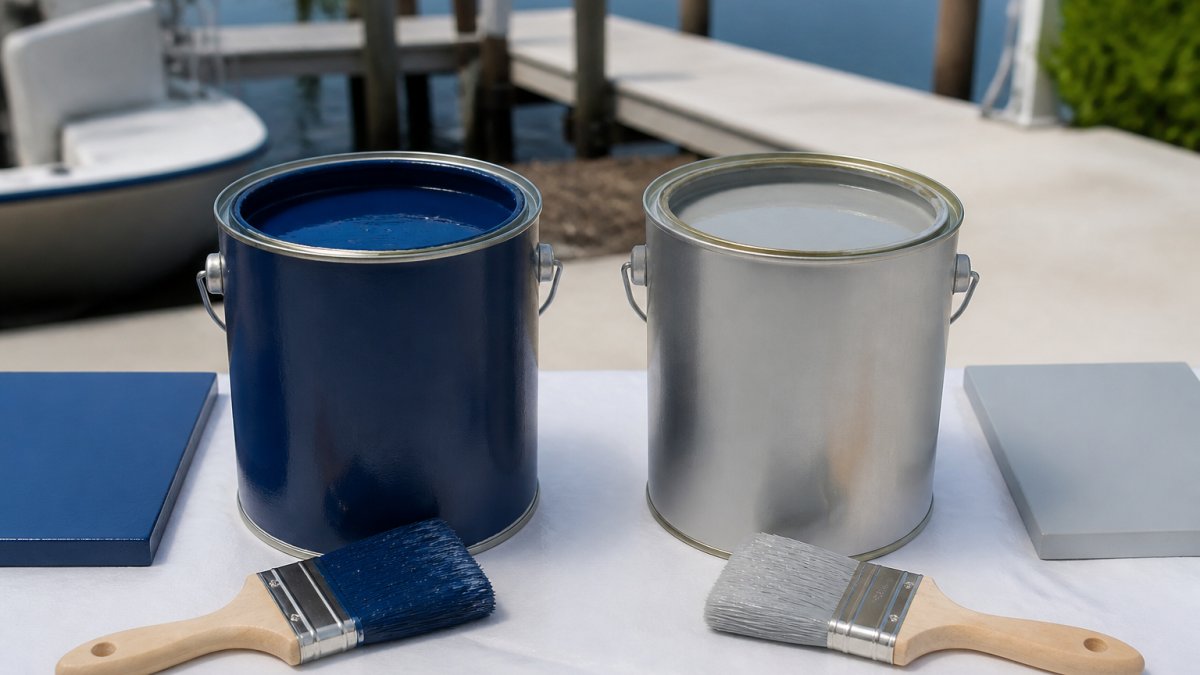
The two paint families differ in resin chemistry, flexibility, and how they handle constant wetting. Marine coatings use resins formulated to stay flexible and bond tightly under moisture. Regular exterior paints prioritize breathability and color stability on siding.
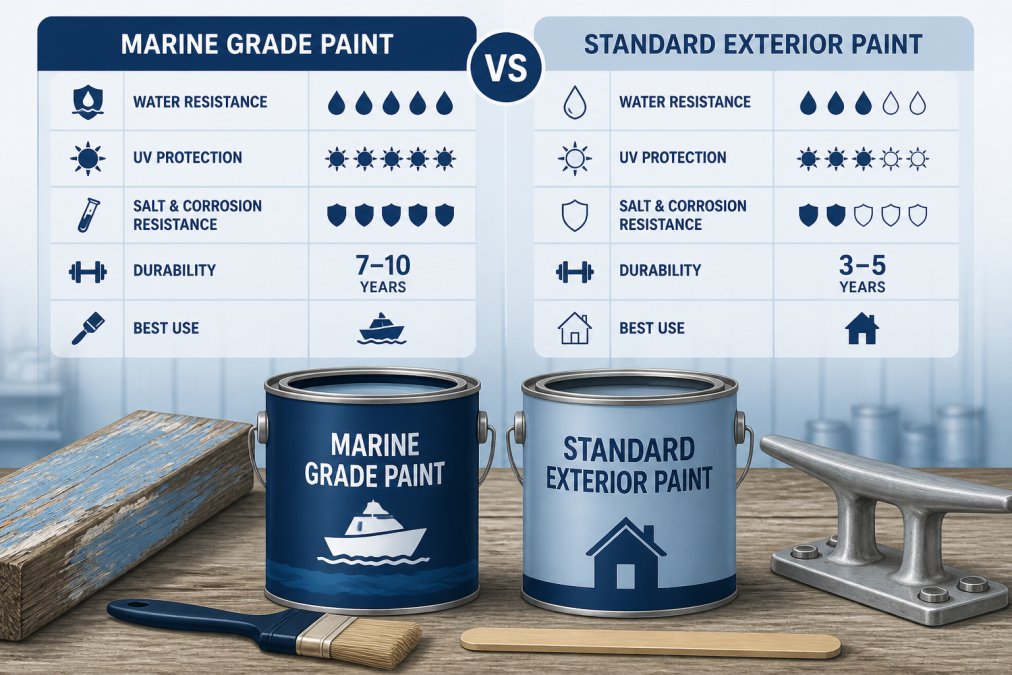
| Feature | Marine Grade Paint | Standard Exterior Paint |
|---|---|---|
| Primary job | Protect against water and salt | Protect against sun and rain |
| Saltwater resistance | High | Moderate |
| Flexibility | High, moves with the surface | Moderate |
| UV and color retention | Good to excellent | Good |
| Antifouling options | Yes, for hulls | No |
| Color range | Limited | Wide |
| Cost per gallon | Higher | Lower |
| Best surface | Boats, docks, metal near water | Siding, trim, stucco |
Resin Chemistry and What It Means for Saltwater and Moisture
Marine resins are built to hold a film under constant moisture. That means better adhesion on wet or damp surfaces and less blistering when water vapor pushes through. Standard exterior acrylics cure to a harder film, which resists dirt and fading but cracks sooner on surfaces that flex, like wood planks and metal.
The practical takeaway: on a surface that moves or stays damp, flexibility beats hardness. On a stable, dry wall, hardness wins.
Substrate-by-Substrate: Primer and Compatibility Notes
The same two cans behave very differently depending on what they touch. Use this as a starting point, then confirm with the manufacturer's data sheet for the specific product.
- Wood (planks, trim, docks): Flexibility is the deciding property. Marine enamels and flexible exterior acrylics both work above the waterline; below it, use a marine system. Prime bare wood with a compatible primer before the topcoat. Skipping primer is the most common cause of sheet peeling.
- Fiberglass: Solvent-based marine topsides and polyurethane coatings are common above the waterline; below it, antifouling systems apply. Surface prep means dewaxing and sanding to a dull finish so the coating can bite. Standard exterior paint can work on sheltered, above-water fiberglass but offers less abrasion resistance.
- Aluminum: Oxidation must be removed before any coating. A conversion coating or etch primer is typically used, followed by a compatible topcoat. Standard exterior paint over unprepared aluminum is a short-lived fix.
Where the Two Categories Overlap
Above the waterline, in sheltered spots, the gap narrows. A premium exterior acrylic on a shaded, well-drained wall can perform close to a marine product for years. The marine product still wins on abrasion, salt spray, and metal corrosion control, but the premium is hard to justify when the surface stays mostly dry.
Best Paint for Salt Air Exposure: What Holds Up and What Fails
The best paint for salt air exposure combines tight adhesion, flexibility, and UV stability.
Coatings that fail first are the rigid ones. Hard films crack at joints and fasteners, then salt gets under the edge and lifts the paint from below.
What holds up:
- Flexible marine enamels on wood and metal
- Epoxy primers under a topcoat on bare metal
- High-quality acrylic latex on sheltered walls set back from the spray zone
Surface preparation decides more outcomes than product choice. A premium coating on a dirty, poorly sanded surface fails faster than a mid-range coating applied right.
Marine Paint for Wood: Planks, Trim, and Docks
Marine paint for wood needs flexibility above all else. Wood swells and shrinks with moisture, and a rigid film cracks along the grain within a season or two. Marine coatings for wood are formulated to stretch with that movement.
On docks and decking, abrasion matters as much as moisture. Foot traffic, debris, and constant wetting wear a finish fast. A flexible marine enamel with a compatible primer gives the best combination of movement tolerance and wear resistance.
For interior trim and sheltered wood on a coastal home, a quality exterior acrylic often makes more sense. It costs less, comes in more colors, and holds up fine when it's not getting splashed.
Marine Paint for Metal: Aluminum, Steel, and Corrosion Control
Marine paint for metal exists to stop corrosion. Salt air attacks aluminum and steel quickly, and once corrosion starts under a film, the paint lifts from beneath.
For aluminum, the surface needs proper preparation to remove oxidation before any coating goes on.
A common mistake is painting over rust or oxidation and expecting the coating to hold. It won't. The corrosion continues under the film and pushes it off.
Exterior Paint Durability Near the Ocean: What the Exposure Demands
Exterior paint durability near the ocean depends on how much salt spray and sun the surface takes. A wall facing the water with full afternoon sun is the hardest case.
The exposure demands three things: a coating that adheres tightly, a film that flexes with temperature swings, and UV stability so the color holds. Miss any one and the finish fails early.
UV Resistance, Color Retention, and Cracking
UV radiation breaks down paint films from the top down. It fades color first, then chalking begins, then the film gets brittle and cracks. Marine coatings and premium exterior paints both include UV stabilizers, but the marine products are tuned for harsher exposure.
Cracking is the visible end stage. By the time you see it, the film has lost its flexibility. The fix is a full recoat after proper preparation, not a patch job.
When Standard Exterior Paint Is the Right Choice
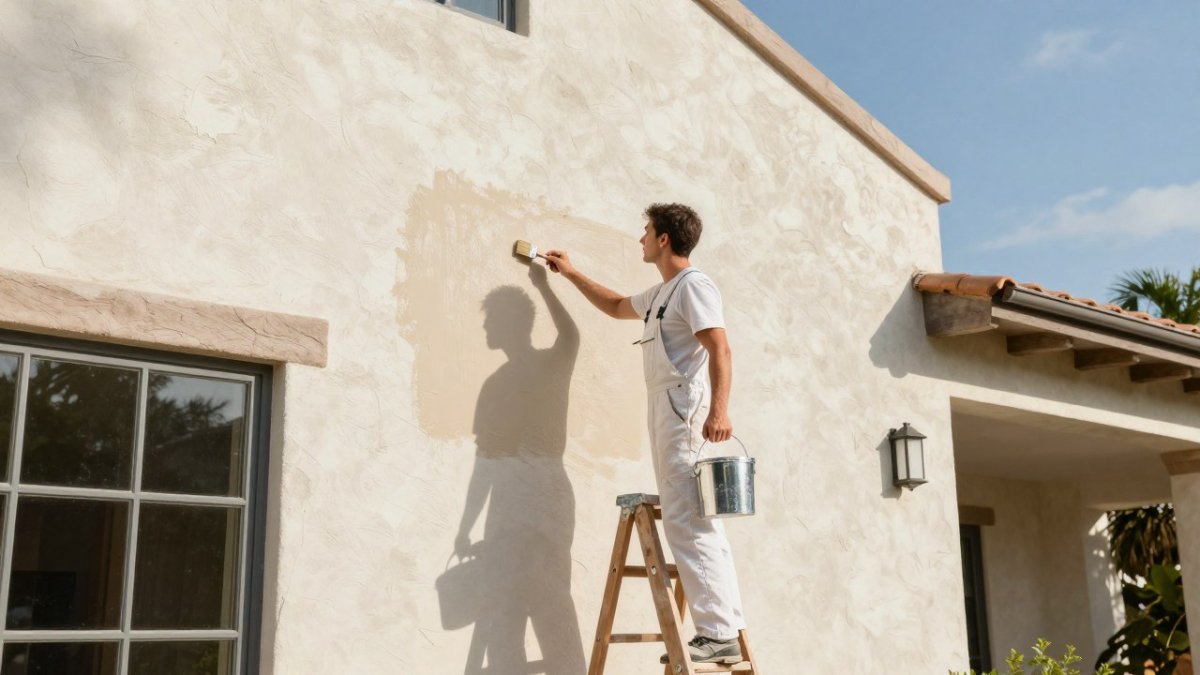
Standard exterior paint is the right choice for most house walls, even near the coast. Modern exterior acrylics resist moisture, hold color, and cost far less than marine coatings. For siding, stucco, and sheltered trim, they perform well.
Standard exterior paint is often recommended when:
- The surface sits well above the splash zone and stays mostly dry
- The surface is stable and doesn't flex much
- Color choice and cost matter more than maximum water resistance
- The surface is vertical and drains freely
The one place we never substitute: below the waterline. Standard paint fails there, full stop.
Cost, Lifecycle Value, and a Quick Decision Framework
Cost and lifecycle value rarely favor the cheaper can. A lower-cost coating that fails in two years costs more than a marine product that lasts five, once you count labor and prep. Labor usually outweighs the paint cost on any repaint, so the coating that avoids one repaint often pays for the price difference on its own.
The Lifecycle Math, Without the Guesswork
Rather than quote a single price, price the job by total cost of ownership. The inputs are straightforward:
- Purchase price per gallon for primer and topcoat.
- Coverage rate from the data sheet, so you know how many gallons the job needs.
- Preparation labor, washing, sanding, masking, and priming usually cost more than the paint itself.
- Application labor per coat, times the number of coats specified.
- Recoat frequency for the exposure, which drives how often steps 1-4 repeat.
A common pattern is that preparation and labor dominate the total, which is why a coating that lasts two extra years often beats a cheaper can on the first avoided repaint. Use qualified language with your painter: ask for the recoat interval they expect for your exposure, then compare total cost over that window rather than sticker price.
A Decision Framework for Exposure Conditions
Work through these questions in order. Stop at the first "yes" that applies.
| Question | If yes | If no |
|---|---|---|
| Will the surface be continuously or intermittently immersed? | Marine antifouling or below-waterline system | Go to next question |
| Does the surface get regular salt spray or splash? | Marine enamel or marine topcoat system | Go to next question |
| Is the surface bare metal exposed to salt air? | Epoxy primer plus marine topcoat | Go to next question |
| Does the surface flex (wood planks, metal fittings)? | Flexible marine or premium exterior coating | Go to next question |
| Is the surface a stable, well-drained wall set back from the water? | Standard exterior acrylic | Reassess exposure with a painter |
When Standard Exterior Paint Is the Acceptable Alternative
Standard exterior paint is acceptable when the surface stays mostly dry, drains freely, and does not flex much. That covers most house walls, sheltered trim, and stucco set back from the spray zone. It is not acceptable below the waterline, on surfaces that stay wet, or on bare metal in salt air. The distinction is occasional splash versus continuous exposure, not distance from the water alone.
Application Steps That Decide the Outcome
- Wash the surface to remove salt, dirt, and chalking.
- Scrape and sand loose or failing coating back to a sound edge.
- Repair defects in wood or metal before painting.
- Prime bare surfaces with a compatible primer.
- Apply the topcoat in the manufacturer's specified coats and recoat window.
- Check adhesion on a test patch before committing to the full surface.
Coating compatibility matters at every step. A primer and topcoat from different systems can fail together even when each works alone. Stick to one manufacturer's system where you can.
Frequently Asked Questions
What is the difference between marine-grade paint and standard exterior paint?
Marine grade paint is formulated for constant saltwater, UV, and abrasion exposure. It typically uses more flexible resins and higher-grade pigments, so the film moves with the surface instead of cracking. Standard exterior paint is built for houses: it handles sun and rain but not immersion or salt spray. A top-range exterior acrylic latex cures to a tighter, harder film, which is fine on a sheltered porch but less forgiving on a dock or boat hull. The practical difference shows up in service life near the water.
Can you use marine paint on a house exterior?
You can, but it is rarely the best value for a whole house. Marine coatings cost more and are designed for smaller, high-exposure surfaces like trim, shutters, doors, and dock boards. On stucco or siding, a quality exterior acrylic latex with proper primer gives better color retention and easier recoating. Use marine paint on the pieces that take direct salt spray, and standard exterior paint on the broad wall areas. That split keeps the budget sensible without sacrificing protection where it matters.
Is marine-grade paint better than exterior paint near salt air?
For surfaces that get hit by salt spray, rain, and sun daily, marine grade paint usually lasts longer. Its film stays flexible and resists blushing and chipping better than standard exterior paint. For walls under an overhang or on a protected side of the house, exterior paint performs well and costs less. The best paint for salt air exposure depends on the surface: marine coatings on rails, trim, and metal, exterior acrylic latex on sheltered siding and stucco.
Does marine-grade paint require special surface preparation?
Yes. Marine coatings demand clean, sound substrates. Wood needs sanding, priming, and sometimes a penetrating sealer. Metal needs degreasing and a corrosion-resistant primer, especially aluminum and steel. Fiberglass needs sanding and a solvent wipe. Skipping prep is the main reason marine paint fails early. Power washing, patching, and priming are not optional extras; they decide whether the coating holds. A professional assessment of the surface saves money over recoating a failed job.
Can standard exterior paint protect surfaces exposed to salt air?
Standard exterior paint can protect surfaces near the ocean if the exposure is moderate. A high-quality acrylic latex with UV inhibitors and a flexible primer handles sun and humidity well on sheltered walls. It will not match marine paint on a dock, boat, or metal railing that gets direct salt spray. For exterior paint durability near the ocean, choose a top-tier exterior product, apply the correct primer, and expect to recoat sooner than you would with a marine coating on high-exposure surfaces.